There’s a retention problem every fintech team already knows about.
Fintech app user retention strategies are endless, but according to Business of Apps’ Finance App Benchmarks, the average finance app still retains just 4.2% of users by day 30. While acquisition budgets grow and install volume climbs, the majority of those acquired users open the app once, complete onboarding, and never return.
The reasons are predictable. Financial apps serve a functional need: users show up to make a payment, check a balance, or complete a transaction. Once the task is done, there is no motivation to return until the next task.
That is the retention gap. And most fintech teams are trying to close it with the same tools that created it: more push notifications, better onboarding flows, and incremental UX improvements.
There is a different approach, one that is already sitting inside the daily habits of your existing users.
Your users are already mobile gamers
Here is the insight that changes the equation: your fintech users and mobile gamers are, to a significant degree, the same people.
According to Sensor Tower’s State of Mobile 2026, there are 3 billion mobile gamers globally, and mobile gaming accounts for 55% of total gaming industry revenue, making it the dominant platform by every measure. In the US alone, that audience reaches 256 million monthly active players.
The demographic overlap with fintech is direct. Newzoo’s 2025 Global Games Market Report identifies the 18–34 age group as the largest mobile gaming segment, with Millennials showing 88% engagement rates on mobile gaming platforms. These are the same demographics driving fintech adoption: people who manage money on their phones, invest through apps, use BNPL at checkout, and open digital bank accounts, all on the same device they pick up 4 to 6 times a day to play games.
The average mobile gamer spends 8.5 hours per week playing, across sessions in the morning, during lunch, and while winding down at night. That consistent, high-frequency behavior is what makes mobile gaming so valuable as a behavioral model for how to build daily engagement inside any app.
The opportunity for fintech is not to reach gamers somewhere else. It is to bring that same engagement behavior into your product.
What a gaming rewards layer actually does
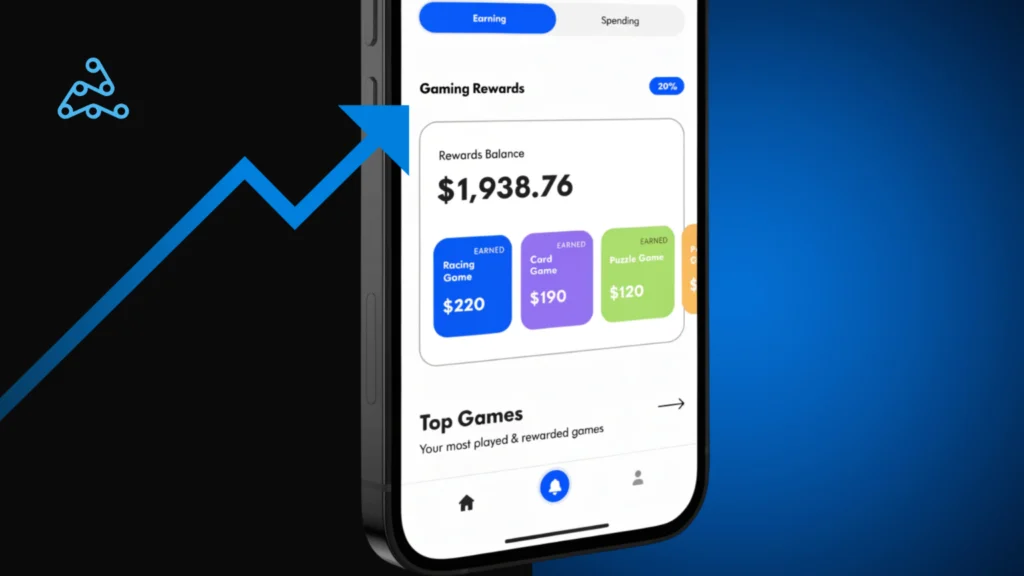
A gaming rewards layer is not a mini-game added to a banking app for novelty. It is a structured engagement mechanic that gives users a reason to open your app every day, independent of whether they have a financial transaction to complete.
The model works like this: users earn real rewards (cashback, points, in-app currency) by discovering and playing games directly within the fintech app. Each session creates a verified interaction that the user chooses to engage and complete to earn something tangible. That opt-in behavior is fundamentally different from a push notification that interrupts a user mid-day. The intent is real because the choice was real.
At AdAction, we call this Value Exchange Media.
It is the principle behind AdGem Play™, a white-label arcade ad unit solution built specifically for apps that want to drive daily active usage, increase transaction frequency, and build compounding LTV without acquiring new users.
The mechanics compound over time. A user who opens your fintech app for a gaming session on Monday is more likely to also check their balance, notice a product, or complete a transaction.
Daily sessions create familiarity that deepens trust. Trust increases product adoption across the full range of features the user was otherwise ignoring.
The business case: mobile gaming as a fintech app user retention strategy backed by data
The performance case for gaming engagement inside fintech is no longer theoretical. The market has been running this experiment for long enough that the numbers are consistent across sources.
Research cited by Netguru shows that gamified experiences increase customer engagement by 48%, and that user actions on banking platforms increase by 207% when game mechanics are integrated into the product experience. The gamification fintech market is growing from $15.43 billion in 2024 to a projected $48 billion by 2029, a signal that major financial institutions have already validated the strategy internally.
On the retention side, StriveCloud’s analysis of fintech platforms using variable rewards found engagement remained 35% higher over 90 days compared to traditional banking apps. Gamified financial wellness programs specifically show 45% higher participation rates than static loyalty programs.
The LTV implications follow directly. Apps with effective gamification report up to 7x higher lifetime value compared to non-gamified equivalents. When a user builds a daily habit around your app, even a habit as simple as a five-minute gaming session, the window for monetization, cross-sell, and retention expands significantly.
Revolut’s experience with RevPoints is the clearest real-world proof point. The gaming-influenced loyalty program attracted 6.6 million users almost immediately after launch, and Revolut reported a record $1.4 billion profit in 2024, in part by converting sporadic fintech users into daily active ones.
What this looks like in practice with AdGem Play™
AdGem Play™ is a plug-in gaming rewards solution that integrates directly into fintech apps. Users access a curated selection of games inside the app, earn rewards for completing sessions and milestones, and build a daily engagement habit that increases the frequency and depth of their interaction with the full product.
The solution is built on AdAction’s neutral infrastructure, meaning AdGem Play™ does not compete with your product, your acquisition strategy, or your existing user relationships. The data, the users, and the loyalty belong to you.
The bottom line
Fintech’s retention problem is not a product problem. The apps work. The onboarding flows are optimized. The push notification sequences are running.
The problem is that financial transactions do not happen every day, but your users pick up their phones and open games 4 to 6 times a day without being asked.
The brands that close the retention gap in the next 18 months will not do it by improving their offboarding recovery sequences. They will do it by becoming part of a daily habit that was already there.
If you want to see what AdGem Play™ looks like inside your product, our team is ready to walk you through it. Contact us here.
Frequently asked questions
What is a mobile gaming rewards layer for fintech?
A mobile gaming rewards layer is a feature integrated into a fintech app that lets users discover and play games in exchange for real rewards: cashback, points, or in-app currency. It creates a daily engagement habit inside the product, increasing retention and LTV without requiring new user acquisition.
Why are mobile gamers a relevant audience for fintech brands?
Mobile gamers and fintech users overlap significantly in demographics. The 18–34 age group represents both the largest mobile gaming segment (Newzoo, 2025) and the core fintech adoption cohort. With 3 billion mobile gamers globally spending an average of 8.5 hours per week playing (Sensor Tower, State of Mobile 2026), the daily habit already exists; the opportunity is to connect it to your product.
How does gamification improve fintech app retention?
Gamification introduces a non-transactional reason to open the app daily. Research shows fintech platforms using variable reward mechanics retain users at rates 35% higher over 90 days compared to standard apps. By creating a habit loop independent of financial tasks, users stay active between transactions, which increases overall session frequency, LTV, and cross-product adoption.
What is AdGem Arcade™ and how does it work for fintech?
AdGem Play™ is AdAction’s white-label gaming rewards product. It integrates into a fintech app and gives users access to games in exchange for real rewards. Each completed session is a verified, opt-in engagement, not an interruption. The result is higher daily active usage, stronger retention metrics, and a loyalty loop that deepens the user’s relationship with the full product over time.